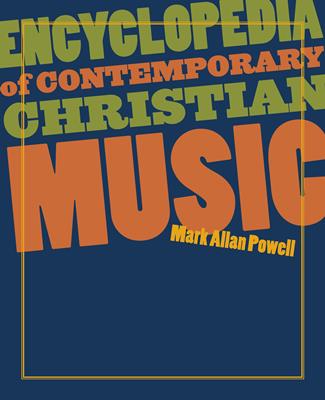
 The Encyclopedia of Contemporary Christian Music by Mark Allan Powell was published in 2002 by Hendrickson Publishers. Powell took a shot at the gargantuan task of creating an encyclopedia of CCM. While there are some notable missing entries (and a few mistakes, like calling Strung Gurus “Strong Gurus”), there is also a wealth of information contained as well. Michael Knott and his various projects and labels are mentioned hundreds of times, as Powell was an obvious fan.
This list is a catalog of all of the times that Knott, one of his bands, or his label Blonde Vinyl were mentioned. They are presented as they appeared in the book, with some mistakes noted. Bold names of bands and individuals does not note importance – this just notes they also had an article in the book.
The entries for Michael Knott, Aunt Bettys, Bomb Bay Babies, Browbeats, Cush, LSU, Windy Lyre, and Strung Gurus were collected into a PDF:
Encyclopedia of Contemporary Christian Music sections on Michael Knott and Bands
These quotations and scans here are posted under Fair Use guidelines for historical critique and review only. All commercial usage of any parts of this book must be cleared with the appropriate copyright holders.
Introduction
“In the ’90s, things got a lot more complicated. With the growth of alternative rock and the viability of marketing through independent labels, many Christian artists rebelled against the stereotypes of their industry. Of course, there had been radicals and rebels all along (T Bone Burnett, The Choir, Daniel Amos, LSU, the Seventy Sevens), but now these increased exponentially until it became commonplace to hear a group say, ‘We are just Christians in a band — we’re not a Christian band.'” (p.11)
Adam Again
“In 2000, M8 Distribution released a three-CD tribute to Eugene and Adam Again. It features one disc of songs performed live by the group with vocals by such artists as Michael Knott and Michael Roe and two discs of concert material from previous years.” (p.23)
The Altar Boys
“Stand’s brother Kevin Lee (Annis) played with Lifesavors and LSU.” (p.34)
Black Carnation
“Completely ignored by the Christian media, their debut album on Michael Knott’s Blonde Vinyl label presents songs of anguish regarding life in a fallen world.” (p.85)
Breakfast With Amy
“As indicated, the album didn’t sell and the none-too-stable record company went under. Michael Knott tried to come to the rescue. A fine judge of unrecognized talent, he signed the Amys to his doomed Blonde Vinyl label. They produced one respectable follow-up that features a slightly psychedelic rendition of the Etta James’ R&B classic ‘Tell Mama.'” (p.108)
“As Blonde Vinyl was in the throes of bankruptcy, The Amys scraped together whatever they could find for what is sometimes referred to as their ‘worst-of’ collection (Product # bvcd 3482 [love gift]), an assortment of previously unreleased material presented without any distinguishable conceptual focus.” (p.108)
The Choir
“The rotation of bass players indicated above is partly due to founding member Tim Chandler’s other commitments, especially his comembership in Daniel Amos — and to Mike Sauerbrey’s similar duties as a sometimes member of LSU.” (p.168)
Kevin Clay
“His first solo album, produced by Michael Knott, was viewed by 7ball magazine as an attempt ‘to document how a creative artist can fall away from God in such a public and pitiful manner, and yet still return to the peace and grace of the Almighty’s love.’ It may have been that — but it was also an attempt to deal with the dearth of peace and grace that he had experienced in some circles while people were watching him fall.” (p.180)
“He also appends eleven (!) bonus tracks, including live songs, demos from the Watch Me Fall sessions, and two interesting cover songs: the Sex Pistols’ ‘Pretty Vacant’ and Michael Knott’s ‘Rock Stars on H.'” (p.180)
“For trivia buffs: According to True Tunes, the songs on Watch Me Fall are presented in a different order than Clay intended. To hear the album as ‘a narrative’ the tracks should be played in the following sequence: 3, 10, 7, 9, 6, 4, 8, 5, 1, 2, 11, 13, 12, 14.”
Common Bond
“Chuck Cummings went on to play drums with a number of high profile Christian bands, including the Aunt Bettys, Dakoda Motor Co., Fanmail, and LSU.” (p.190)
Dakota Motor Co.
“After the group disbanded, Chuck Cummings (who had previously played with Common Bond and LSU) joined the Aunt Bettys and Fanmail.” (p.225)
Dead Artist Syndrome
“For Prints of Darkness the Dead Artists included Michael Knott along with Mike Sauerbrey (of LSU and The Choir) and both Gym Nicholson and Ojo Taylor of Undercover.” (p.243)
Deitiphobia
“The album titled Fear of the Digital Remix was a compilation of material from these first two projects, but of an odd sort. One critic called it ‘Deitiphobia meets an insane butcher.’ The butcher in question was Michael Knott, known for his solo work and for his albums with such bands as LSU and Aunt Bettys, and also former head of Blonde Vinyl records. He remixed the Deitiphobia tracks with radical alterations (spliced songs together, layering them on top of each other, adding samples, etc.) and even gave them all new titles. Some love it, some hate it, but most agree that it is almost more of a Michael Knott album than one by Deitiphobia.” (p.249)
“Knott provides some guitar and vocals for Clean.” (p.250)
Dodavahu
“The group played together for some years and toured (with different drummers) with such acts as LSU, Mortal, and Bride.” (p.264)
Elder
“Strong inferences from Michael Knott and LSU are also detectable.” (p.294)
EDL
“The group came back with an even harder and heavier sound on American Standard, produced by Michael Knott.” (p.312)
“Jeff Elbel, the new bass player, had previously played with Farewell to Juliet, LSU, and Sunny Day Roses.” (p.312)
Fanmail
“[Scott] Silletta gathered a bunch of his friends from other bands (Nick Garrisi from Quayle, Erik Tokle from Rich Young Ruler, Chuck Cummings from Aunt Bettys) to record some songs that he had written — those featured on the debut EP and first full-length album.” (p.318)
Farewell to Juliet
“Jeff Elbel has played on a number of projects by other artists, including the album Hope by Blackball and Dogfish Jones by LSU.” (p.319)
Five O’Clock People
“The group also covers LSU’s “Blame.”” (p.332)
The Kreepdowns
“Ed Benrock has also drummed with LSU and Mortal.” (p.502)
Robin Lane (and The Chartbusters)
“Most of Lane’s songs were about love and romance, and they often reflected on those topics with a deep appreciation for pain and hardship. In those days before The Choir or LSU this seemed strange to Christian music fans, and Lane was challenged by Christians as to why her lyrics had to be so depressing. ‘I don’t know,’ she responded. ‘That’s just me. I look at the world and I see one unhappy mess.’ Then she continued, ‘And Christianity is very much of the world.'” (p.512-513)
The Lassie Foundation
“The Lassie Foundation represents a new incarnation of Eric Campuzano and Wayne Everett of The Prayer Chain fame. The two also played together in Starflyer 59 and Cush and enjoy a somewhat legendary status among fans of progressive alternative Christian rock.” (p.525)
The Lifters
“The California band was formed by three members of The Lifesavors’ road crew.” (p.530)
Love Song
“It lacks the edge of Daniel Amos or LSU or the Seventy Sevens.” (p.543)
The Miscellaneous
“[Steph] Loy cites many of Christian music’s premier alternative acts as his major influences — Daniel Amos, LSU, and Steve Taylor, but the band’s sound is wholly unique.” (p.599)
Mortal
“Around this time, Mortal would also contribute the beautiful acoustic song ‘Bleeder’ to the first Browbeats project.” (p.610)
“Wake reveals a very different side to the group, which had temporarily expanded into a live band (with Benrock recruited from LSU).” (p.610)
My Little Dog China
“Clay is something of a Michael Knott protégé and My Little Dog China fits under the general stylistic umbrella of Knott’s LSU.” (p.619)
Larry Norman
“Norman was into rock and roll and, like Michael Knott, he would exhibit the qualities of a stereotypical ‘rock artist’ personality — mysterious, dismissive, manipulative — but, above all, possessed with an undisputed genius that would consistently set him beyond the comprehension or reach of those who would offer (sometimes legitimate) criticisms of his life and his work.” (p.633)
Ojo
“Following Kerry Livgren’s example, Taylor wrote the songs for his Relative album and employed a variety of vocalists to sing them, including John Elefante, Michael Knott of LSU, John McNamara of 4-4-1, and Terry Taylor of Daniel Amos.” (p.647)
Sandi Patty
“Even before Patty sang the national anthem, many Christian music fans had been annoyed that the world at large associated “Christian music” with Amy Grant rather than with T Bone Burnett or Michael Knott or Daniel Amos.” (p.675)
Charlie Peacock
“An undeniable triumph for both Grant and Peacock, ‘Every Heartbeat’ did little to sustain the fan base he had once shared with artists like Michael Knott and Daniel Amos.” (p.684)
Poor Old Lu
“The Chrono compilation exhibits good song selection and includes the admirable ‘Drenched Descent,’ previously available only on the first Browbeats album.” (p.722)
The Prayer Chain
“The four original members of Prayer Chain later played with Cush.” (p.726)
Psalters
“Michael Knott contributes the song ‘Fattened Frothing Swine,’ which seems out of place insofar as it offers third-person commentary on modern lifestyles, whereas everything else is couched in second-person address to God.” (p.733) (it was later verified that Knott did not write this song)
Quayle
“The album was produced by Michael Knott, but the group did not quite attain the alternative credentials that such an association might suggest.” (p.736)
Rainbow Rider
“Beautiful Dazzling Music was recorded on one of Michael Knott’s labels and was intended to be the first in a series that was unfortunately never continued.” (p.741-742)
Rich Young Ruler
“He [Terry Taylor] brought in friends like Michael Knott and fellow Lost Dogs Gene Eugene and Michael Roe to kick the music into a very high gear, and he even cowrote a couple of the best tunes (‘Wearing Me Out,’ ‘Who’s Gonna Make You Happy’).” (p.763)
Michael Roe
“Like Michael Knott and a few others, Roe remains in the Larry Norman tradition of being viewed primarily as a contemporary Christian music artist even though he doesn’t often meet the increasingly defined expectations of the subculture for which that music is targeted.” (p.776-775)
Ruby Joe
“Michael Knott coproduced Sinking the Eight Ball and critics with good memories noticed some similarities to the sound of LSU’s Shaded Pain.” (p.779)
Scaterd Few
“Jawboneofanass has an interesting history in that it was actually recorded three times—first in 1991 for a general market label (Vox Vinyl), then for a different label (Michael Knott’s Blonde Vinyl) in 1992, and then again as an indie project in 1994.” (p.794)
Silage
“Chuck Cummings of LSU and many other bands sits in as drummer for Vegas Car Chasers, and guest rapper Knowdaverbs joins the group on a song called ‘Verb.'” (p.823)
Mike Stand
“For trivia buffs: Mike Stand’s brother is Kevin Lee, who drummed for an early version of LSU called Lifesavors.” (p.864)
Starflyer 59
“Martin was raised in Southern California in a strict home that did not allow any ‘secular music.’ Given such deprivation, he chose his influences well, soaking up Daniel Amos (whose Alarma Chronicles he once called ‘my favorite records of all time’) and LSU (whose Shaded Pain he once called ‘the best album ever, Christian or secular’).” (p.865)
Terry Scott Taylor
“‘Will Have to Do for Now’ is a gorgeous and theologically profound song from the Browbeats’s Unplugged Alternative album;” (p.935)
Undercover
“During what turned out to be a temporary break, Taylor became active as a producer, working on the classic Shaded Pain album for LSU and on a project for his brother, who recorded as Pat Nobody (a.k.a. Nobody Special).” (p.974)
“In 1997, 7ball would say, ‘Like many bands that get to a certain place first, Undercover was not necessarily the best at what they did. Daniel Amos took new-wave to new heights, The Choir grafted complex arrangements onto basic chord structures, and Michael Knott broke the mold when it came to honest lyrics. But none of those artists would likely have achieved what they did without the contribution of Undercover.'” (p.975)
Uthanda
“The band’s original drummer was Chuck Cummings, who has played with LSU, Dakoda Motor Co., and Aunt Bettys, but he left before the first album was recorded.” (p.977) (note that Cummings actually was listed as the drummer on their debut album Groove in 1991)
Value Pac
“The album [Incognito] was produced by Dennis Danell (guitarist for the general market band Social Distortion), who also died before the project was completed. ‘He was definitely a believer,’ Sheely told 7ball of the late Danell, a legend in the punk world (cf. Strong [sic] Gurus). Incognito continues to allow the band’s original new-school punk sound to be affected by healthy doses of classic rock, such that Bandoppler would liken the sound on some tracks (e.g., ‘Showdown’) to that of non-punk bands like Tragedy Ann or even Aunt Bettys.” (p.985-986)
Veil of Ashes
“The group built a cult following sufficient to justify a compilation album on Michael Knott’s doomed Blonde Vinyl label.” (p.990)
The Violet Burning
“The strained history of the progressive and critically acclaimed rock band The Violet Burning parallels that of groups like LSU in certain ways. The band began as a somewhat naive outreach ministry for a local church but came to prize artistic expression over propaganda in ways that put them on the fringe of the Christian music industry. Also like LSU (or the very different sounding Vigilantes of Love), The Violet Burning has turned out to be less of a band than a musical environment for its only consistent member.” (p.1002)
The Wayside
“A proponent of art over propaganda, Thompson has often been responsible for seeing that non-industry darlings like Michael Knott, the Seventy Sevens, and the Vigilantes of Love get the respect they deserve.” (p.1028)
White Heart
“Some critics also objected to what they considered to be shallow lyrics. At a time when the most acclaimed Christian bands (The Choir, Daniel Amos, LSU, the Seventy Sevens) were opting for poetic imagery and for writing Christian songs about life in general, White Heart favored the DeGarmo and Key or Petra approach: simple, direct songs with explicit evangelical messages.” (p.1033)
Wild Blue Yonder
“Another historical souvenir is ‘Cryin’ Eyes,’ which was cowritten by Michael Knott.” (p.1036)
“Brigandi went on to become a successful producer, responsible for the classic LSU album Shaded Pain.” (p.1036)
Other Blonde Vinyl Mentions
Several Blonde Vinyl bands have articles, even though the articles don’t mention Michael Knott:
- Acoustic Shack (p.21)
- Dance House Children (p.226)
- Duraluxe (a.k.a. Fluffy) (p.274-276)
- Fear Not (a.k.a. Love Life) (p.323)
- Global Wave System (p.366, but no mention of Blonde Vinyl)
- Lust Control (p.550-551)
- Steve Scott (p.799-800)
- Tribe of Dan (p.960, but no mention of Blonde Vinyl re-issue of their first CD)
- X-Propagation (p.1060, but no mention of Blonde Vinyl)
See all of the articles on Blonde Vinyl Bands
The Undercover article mentions Black and White World on p.975 (“Undercover’s long-standing lineup fell apart after Devotion, but the group would make one more album with a new singer (Rob Gallas, formerly with the band Black and White World) and with two different drummers (Chuck Cummings, who has also played in Common Bond, Dakoda Motor Co., LSU, Aunt Bettys, and Fanmail) and David Raven of The Swirling Eddies).”)
Wigtop is mentioned in the Deitiphobia article on p. 250 (“Brent Stackhouse’s wife Heather also released a female industrial project called Wigtop.”)